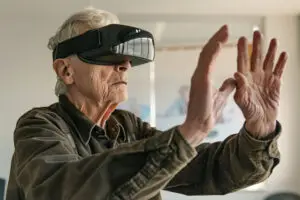
This month (May 2026) I complete my seventy-seventh year and a few more than fifty years following Jesus. Not all of those have been glorious as I dragged plenty of baggage from my old life. At this late stage, there is much I desire to leave far behind, to put out of memory but letting the old man pass away isn’t as certain as leaving my old body behind for what Jesus has prepared for my next. No, I am healthy enough but my threescore years and ten are in the rear-view mirror and growing faint.
I find among my senior friends and within myself a tendency to remember fondly parts of the past that would be better forgotten, those pleasures of activities that are now less participatory and more reminiscences. One of the issues we have is the faultiness of glorifying what really wasn’t as wonderful as we idealize with age. We weren’t quite as productive, quite as rugged, quite as deliberate, quite as accomplished as our memories think we were. Yes, there are those special moments but they are past and seldom can or should be recaptured. What we did then was segue to what we are equipped to accomplish now. One of the common traits of those of us in our latter years is that we are no longer able to compete with our former selves. We are not who we were. Seventy-five is not the new fifty except that we have better healthcare, greater opportunities, more prosperity and more information than twenty-five years ago.
With the last 25 years came the abundance of internet access for information and dis-information; separating news from opinion has been confused by the multiplicity of sources all presenting themselves as Truth and demanding our agreement with what is unsubstantiated yet popular. The ease of communication enabled by the smartphone is only twenty years old and yet has become so ingrained globally that culture has been unable to grow appropriate mores to keep it valuable without misuse. Life has become instant without a long vision of values, responsibilities and consequences. Social media tends to be ‘now’ driven and not have a long historical context. Truth is judged by what is popular for social influencers and not by individual moral values. This moment becomes of paramount importance and must be gratifying to our feelings.
While God acknowledges the past, is fully aware of all that has passed, it is just that: Past. He does not dwell in the past, nor live in the world of ‘what if’ or ‘might have been.’ While the Lᴏʀᴅ ‘changes not’ He is creative and responsive in His expression into the present.
“For I the Lᴏʀᴅ do not change; therefore you, O children of Jacob, are not consumed…” 1
Jesus Christ is the same yesterday and today and forever. 2
In the first verse, ‘I the Lᴏʀᴅ do not change’ is the reason given that the Israelites are not destroyed which is alluded to in Jeremiah’s Lamentation 3:23,
The steadfast love of the LORD never ceases; his mercies never come to an end; they are new every morning; great is your faithfulness. 3
God’s character and values do not change no matter what He experiences. We tend to be reactive but He is responsive, continuing to work toward fulfillment of His eternal desires. His past accomplishments are held more loosely than ours—He is not anchored in the past but continues on in accomplishing His design.
“The former things I declared of old; they went out from my mouth, and I announced them; then suddenly I did them, and they came to pass.” 4
God is forward progressing, accomplishing what He is allowed to do in our lives and then moving on in His ongoing pattern of redemption. While we anchor ourselves in our pasts, He has a wider perspective than we:
O Lᴏʀᴅ, what is man that you regard him, or the son of man that you think of him? Man is like a breath; his days are like a passing shadow. 5
What we see as permanence has the essence of our own shadow, it is fleeting, ephemeral, passing away as quickly as the shadow to the waning day. God is not so:
“For behold, I create new heavens and a new earth, and the former things shall not be remembered or come into mind.” 6
The Lᴏʀᴅ has not just been creative ‘in the Beginning’ but continues to do new things, things that are ‘new’ in our perception but which He has designed from the foundations of all that is. It does not yet appear to us created beings all that God has in mind for expression of His creativity. What is past is preliminary and preparatory to what is coming. Jesus revealed to the Apostle John in his Patmos vision just how radical the future is from the past:
And I saw the holy city, new Jerusalem, coming down out of heaven from God, prepared as a bride adorned for her husband. And I heard a loud voice from the throne saying, “Behold, the dwelling place of God is with man. He will dwell with them, and they will be his people, and God himself will be with them as their God. He will wipe away every tear from their eyes, and death shall be no more, neither shall there be mourning, nor crying, nor pain anymore, for the former things have passed away.” 7
It is inconceivable to the human mind what God has yet to accomplish. Our limitation to what is familiar means we have a propensity for dragging the past into not only the present but also our conception of the eternal future. Our main challenge is seeing God as able to redeem us and create something ‘new’ out of our past so that we can be part of His present and future. The division between what we were—Past—and what we are to become—Present / Future—rests upon allowing Him to change our orientation from the world toward Himself,
Do not love the world or the things in the world. If anyone loves the world, the love of the Father is not in him. For all that is in the world—the desires of the flesh and the desires of the eyes and pride of life—is not from the Father but is from the world. And the world is passing away along with its desires, but whoever does the will of God abides forever. 8
Allowing the old man to pass away goes beyond physical death but is fundamental to putting off the old man to make way, putting on the new in the image of Christ Jesus.
In these you too once walked, when you were living in them. But now you must put them all away: anger, wrath, malice, slander, and obscene talk from your mouth. Do not lie to one another, seeing that you have put off the old self with its practices 10 and have put on the new self, which is being renewed in knowledge after the image of its creator. 9
The same composer of the Revelation of Jesus Christ, the Apostle John, in one of his last letters wrote reminding believers in Jesus that what God was continuing to do was neither Old or New Testament but the continuing command of God to live in Him as changlings, letting the darkness of our past, pass away and to let the true Light shine through our present lives,
Beloved, I am writing you no new commandment, but an old commandment that you had from the beginning. The old commandment is the word that you have heard. At the same time, it is a new commandment that I am writing to you, which is true in him and in you, because the darkness is passing away and the true light is already shining. Whoever says he is in the light and hates his brother is still in darkness. Whoever loves his brother abides in the light, and in him there is no cause for stumbling. But whoever hates his brother is in the darkness and walks in the darkness, and does not know where he is going, because the darkness has blinded his eyes. 10
Yes, the old man is passing away but the Lᴏʀᴅ has a vision of the new man created in the image of Jesus. We can leave the past behind and walk in His newness of life if we allow Him to do His creative work in us.
Revelation 21:1-4 (ESV) - https://www.blueletterbible.org/esv/rev/21/1-4/s_1188001
All Scripture references from the Blue Letter Bible, ESV
at https://www.blueletterbible.org
The Holy Bible, English Standard Version copyright © 2001, 2007, 2011, 2016, 2025 by Crossway Books and Bibles, a Publishing Ministry of Good News Publishers. All rights reserved.