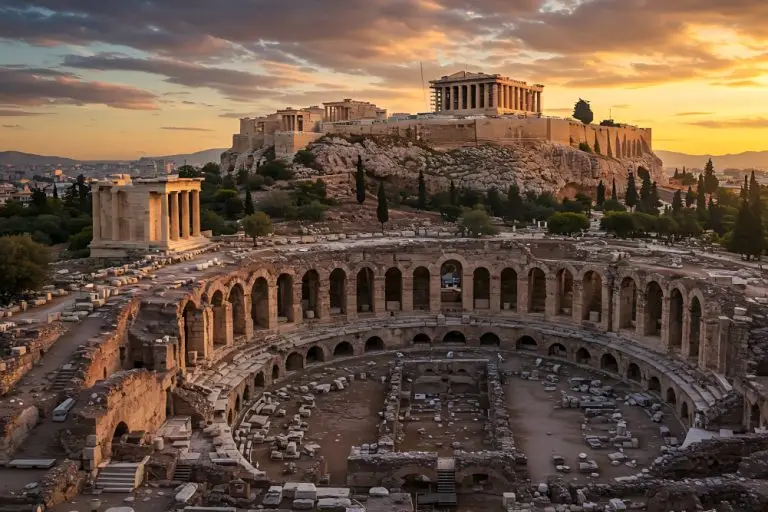
In Acts 17 we find the Apostle Paul has continued his journey deep into Greece. He had already been through several large cities but now is found in Athens, the cultural and educational hub of the Greek civilization. Yes, it was now a Roman province but the Greek influence still was predominant in the lives of the citizenry. Paul was being pursued through the cities of Asia Minor on into Greece by Jews who devoutly opposed his preaching of Jesus Christ as the truth of the Lᴏʀᴅ. The Jews were agitating, stirring up any crowd against him. He has been sent on to Athens and arrives before both his fellow supporters and the Jewish agitators. As was his custom, he began to engage the locals in conversation about the true God he served. In Athens, there was a public area, the Areopagus, where the public was given to presenting and debating any element of life. The various schools of thought included philosophies widely ranging from self-denial to self-indulgence. Paul had already spoke in smaller venues but was now encouraged to present his ‘new’ teaching about Jesus and the resurrection in the open forum. Paul accepted the challenge.
Athens was the philosophical hub of the ancient world and given to exploring philosophy and wisdom after the Greek model. It was out of this philosophical model of reasoning about the minutia of the substance of life and values that came the ‘very religious’ and ‘city full of idols’ observations about the culture. They were not interested specifically in accepting new truth as much as the participation in debate, argument, rationalizing, winning and losing, demonstrating their own superior skills. Into this Paul launches his presentation of truth by God.
In his 1991 book, Eternity in Their Hearts – The Untold Story of Christianity Among Folk Religions of Ancient People, 2 author Don Richardson in Chapter One, Peoples of the Vague God, tells the historical story behind the altar to the Unknown God. He recounts how this altar came to be and how the Greeks would have known the backstory of how this ‘unknown’ god had intervened in crisis and yet was lost to their understanding.
Paul was not doing that preaching thing of making something up but had been in Athens long enough to both see, learn and understand the history behind the Athenian ‘religions’ and recognized the truth of God represented in this lost history. It was from that point he proceeded to declare Jesus and His resurrection.
In the beginning, God created 3 … let us make man in our image. 4 God begins with distinction, a singular pattern according to His likeness. While we may take that to mean we look like God, that is unlikely because, as the revealing of Himself unfolds, we are told that He is spirit, that in His heavenly kingdom there is neither male nor female. ‘Image’ seems more likely to be in or ability to think, determine, choose, be creative, live, be productive but God does not intend for us to be these things without limits—we are after all, finite rather than infinite, our knowledge is not comprehensive and wisdom is not innate as we quickly proved in our first choice apart from God’s input.
Then we get back to that ‘unknown god’ thing. The Athenians had a pantheon of gods they had created through philosophy and reason but we are not that dissimilar. When the Lᴏʀᴅ gave us precepts of character, that which would aide us in staying in agreement with Him, ‘no other gods before me’ and ‘make no images’ were foundational. But we have a bent to be creative in both these faults; we create gods in our perceptions of what must be conforming to our desires or to explain our errors in judgment. We are equally creative in imagery that begins in our desires but which we give substance to through physical or mental idols that we give allegiance to through our attentions, resources and entrusting of our well-being. In the modern age we have to look no further than the social media influencers who tout lifestyles that millions of followers seek after as though that would be the road to fulfillment. The promise is oneness with the fulfillment of all desires through a mystical union with the unknown yet the path is unattainable for there is no true route but only the illusion of the ephemeral, vapors undefined. This is in stark contrast to the reality of what Paul proclaimed:
Paul’s argument is that God is not intending Himself to be unknown but rather has provided the ability to not only seek Him but also to find Him as He is in reality and not as a philosophical phenomena like they had made Him. It was at this point in the proclamation that many rejected culpability and quit listening. Others wanted to put off until another time hearing more. But there were those who accepted the identity of what had been unknown, took the proclamation, believed in the Lᴏʀᴅ God and continued in the revealed Truth.
Life must include an honest evaluation of belief to determine whether it is in the unknowable or if there is a foundation of Truth which can be built upon, if there is substance. The Lᴏʀᴅ gives ample revelation of Truth through the simplicity of the Bible that does not need interpretation but opens up the eyes, ears and heart of those who are open to reality and not simply wanting to philosophize. God’s response to ungod is clear:
Those who claim that God cannot be God because He isn’t fair or according to their expectations deny this ‘visibility’ that God has provided of Himself. His nature is not finite nor unknowable but once we determine to make Him in our own image or according to our own desires, our conception of Him becomes idolatry. Denying leads to futility which leads further into darkness and results in ‘serving the creature rather than the Creator. The gods of the Greek pantheon were all modeled after flawed beings and were doomed to become mortal as they were unable to fulfill the desires of the followers. The Roman deities were likewise modeled in the image of man. The add-on in the Roman world is that those who declared themselves Caesar also declared themselves gods.
Romans One goes on to catalog the outcome of becoming our own gods and it is not pleasant when we take it upon ourselves to fulfill our own desires any way we see fit.
God is only ‘unknown’ when we choose to ignore His revelations about Himself. Yes, the Bible is a long read but if you determine to deny His Lᴏʀᴅ-ship, you should first know His autobiography. There will be a test—your life is at stake.